Skip to content
Feast Design Co.
  • Get the Feast Plugin
  • DocumentationExpand
    • Feast Plugin
    • Feast+
  • Open a Support Ticket
New to Feast? Start Here
Login/Account
Feast Design Co.

Genesis Setup

15
  • Edit Post Info
  • Update Author Bio
  • Modern Navigation
  • Clear Cache ‼️
  • Layout
  • Modern Index
  • Feast Plugin Setup
  • Modern Homepage Setup
  • Modern Menu for Desktop
  • Modern Mobile Menu
  • Sidebar
  • Modern 404
  • Modern Recipe Index
  • Modern Categories
  • Modern Footer

Getting Started

3
  • Migrating to Feast
  • Staging Site
  • Sign Up For The Newsletter

Plugin Settings

18
  • Edit Body Font Size
  • Subscribe button
  • Social Icons
  • Recipe Key
  • Post Template
  • Table of Contents
  • Post IDs
  • Google Trusted Source
  • Edit Leave a Reply
  • Disable Trackbacks
  • Modern Previous + Next
  • Posts per page
  • Breadcrumbs
  • Productivity
  • Smooth scrolling
  • Image unlink
  • Replace recipe card Jump To buttons
  • BETA

Block Editor 101

4
  • Block Editor
  • Block themes
  • Patterns
  • Why we don't support block-level styling

Blocks & Patterns

15
  • Post Template
  • Numbered Lists
  • Table of Contents
  • Full Width Banner
  • Featured Recipe Pattern
  • Why we don't support block-level styling
  • Process Shots
  • Inline Heading Group Block
  • Step Instructions
  • Advanced "Jump To" Links
  • Reader Review
  • Feast Patterns
  • Displaying Post Blocks (FSRI)
  • Displaying Category Blocks (FSCI)
  • Scheduled Categories

Page Templates

3
  • Custom 404
  • How to use Categories
  • Shop page

Customize

8
  • Customizer
  • Customizations
  • Customization Referrals
  • Why we don't support block-level styling
  • Per Page CSS
  • Why you shouldn't make customizations
  • Custom CSS
  • Customization Support

Images

10
  • Post Images
  • Default Image Size
  • Modern post image sizes
  • How thumbnails work
  • Modern Thumbnails (Featured Images)
  • Troubleshooting Featured Images
  • Displaying Post Blocks (FSRI)
  • Process Shots
  • Image Alt Tags
  • Why do my images look different in edit post and live?

Feast+

32
  • What is Feast+?
  • Feast+ Setup
  • Design Kits
  • Feast+ Fonts
  • Feast+ FAQ
  • Feast+ Showcase
  • Feast+ Patterns
    • Top Banner
    • Custom list styling
    • Numbered Lists
    • Full Width Banner
    • Feast+ Footer
    • Feast+ Call to Action
    • Icon Tip Boxes
    • As Seen In
    • Reader Review
  • Feast+ Pre-Built Pages
    • Feast+ Homepage
    • Feast+ Index
    • Feast+ Category Pages
    • Social Landing Page (Link In Bio)
  • Branding & Design
    • Feast Fonts
    • Feast+ Branding & Design
  • Feast+ Features
    • Full-Width Post Header
    • Custom List Styling
    • Colored Numbered Lists
    • Top 10 List Styling
    • Step Instructions
    • Heading Styling
    • Top of Site CTA Banner
    • Custom Background Pattern
  • Design Kits
    • Feast+ Design Kits (Members)
    • Feast+ Design Kit Library
    • Feast+ Design Kit Instructions

Recipes

7
  • Reviews
  • Recipe Key
  • Ingredients
  • Displaying Category Blocks (FSCI)
  • Displaying Post Blocks (FSRI)
  • Featured Recipe Pattern
  • All Recipes

Social Sharing

2
  • Social Icons
  • Tiktok

Logo & Fonts

5
  • Retina Quality Logo
  • Create your logo
  • Edit Body Font Size
  • Fonts
  • Logo

Categories

3
  • Why Isn't the Category Description Appearing?
  • Displaying Category Blocks (FSCI)
  • How to use Categories

Blogging Resources

15
  • Food Blog Sitelinks
  • Photography
  • Understanding "penalties"
  • Food Blog Page Structure
  • Food Blog Site Structure
  • Comments
  • Internal links
  • Analytics
  • Pagespeed
  • SEO for Food Bloggers
  • Modern guidelines for page headings
  • How to Write a Recipe Post
  • Recipe Page Guidelines for Food Bloggers
  • Image Optimization
  • Recipe Update Checklist

Speed & SEO

18
  • Image Alt Tags
  • Speculative Loading
  • Google Trusted Source
  • 301 Redirects, Links, Canonical and Pagespeed
  • Image file size vs. pagespeed
  • Duplicate Content
  • Lazyloading comments
  • CLS
  • Blocking Time
  • SEO
  • Skip lazy loading first post image
  • Horizontal scrolling
  • Smooth scrolling
  • Pagination
  • Pingbacks
  • INP (Interaction to Next Paint)
  • CDNs
  • Site Speed

Legal Resources

5
  • Legal Resources
  • DMCA and Copyright Infringement
  • Copyrights
  • Accessibility
  • Private Label Rights (PLR)

Troubleshooting

10
  • Why do my images look different in edit post and live?
  • Why Isn't the Category Description Appearing?
  • Troubleshoot Plugin Conflicts
  • How to update your theme
  • Feast Plugin FAQ
  • W3 HTML Validation
  • Sorry, this file type is not permitted for security reasons.
  • Troubleshooting Featured Images
  • Either "name" or "item. name" should be specified (in "itemListElement")
  • Clear Cache ‼️

Compatibility

2
  • Compatibility
  • WP 6.7

Integrations

8
  • Ecommerce
  • Ingredients
  • Google Trusted Source
  • Contact Forms
  • Translation
  • WP Recipe Maker
    • Reviews
    • QR Code
    • Ingredients

Developer Resources

6
  • Multisite
  • Feast Plugin Deprecated
  • W3 HTML Validation
  • Feast Plugin: Disable Theme Google Fonts
  • Rethinking the Thumbnails
  • Design
View Categories
  • Home
  • Documentation
  • Genesis (Legacy)
  • Logo & Fonts
  • Edit Body Font Size

Edit Body Font Size

This tutorial features the Feast Plugin, which enhances and extends your theme to improve SEO, pagespeed, accessibility and user experience.

All modern themes from Feast (version 4.0.0+) come with 16px as the standard body font size, for reasons outlined in the font size for food blogs article. This was done to bring the themes more in-line with modern web standards, and to resolve "text too small" errors in Google Search Console.

  • increases ad revenue by decreasing ad density
  • improves user experience by making content more legible
  • improves accessibility by using larger font size, for vision impaired users
  • works perfectly with the system font stack

Even just one year later, we're seeing stories of people benefiting from further increasing the body font size to 18px, and in the case of a few fonts, up to 20px.
As with all changes, you should be designing primarily for mobile devices. Stop editing your site for desktop display - that's not what 80% of your visitors see. Make sure it looks good first and foremost on mobile.

Jump to:
  • Examples
  • Video walkthrough
  • Why increase the body font size?
  • System Fonts
  • Side effects
  • Constraints
  • H1 font size
  • Troubleshooting

Examples

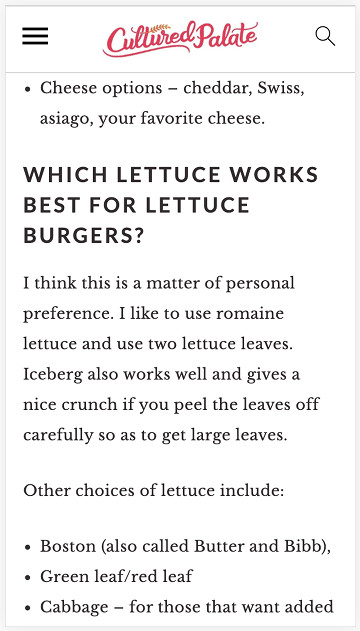
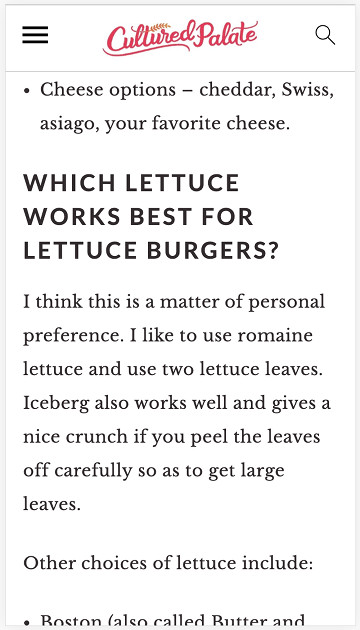
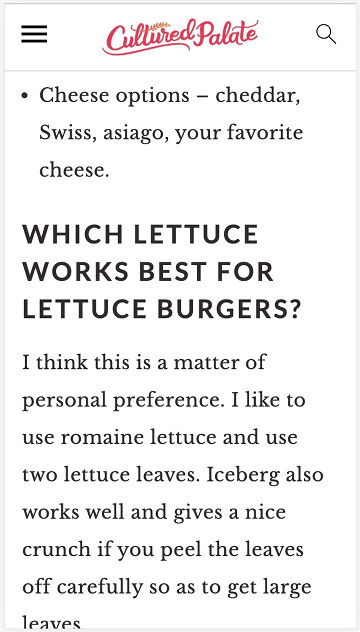
Below is the same page with the body font at different sizes:
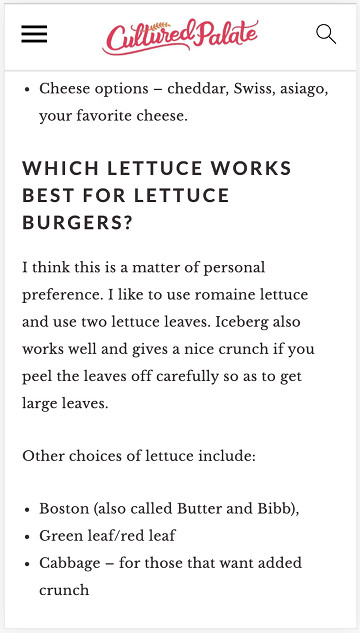
16px - default
18px - possible alternative
20px - only for small fonts
22px - very rarely a good option

Video walkthrough

Why increase the body font size?

The primary reason you may want to increase the body font size is if you've selected a custom font that's too small to read. Different fonts display at different sizes - some smaller, some larger.

This setting makes it easy to specify a larger body font size, which stays in place between theme updates.

Accessibility

A growing percentage of the population is reaching the age where they require assistance with reading small text, which means that a growing percentage of your audience would benefit from a larger text size.

The net effect of this is that it will take more scrolling to get through the same amount of content, because the text takes up more screen space.

And this is fine.

At the Google Webmaster Conference in November 2019, one of the presenting engineers specifically pointed out that scrolling is an intuitive, natural part of the mobile experience, and that extended content is perfectly acceptable on mobile.

Ad revenue

We'd never recommend making a change just for the sake of ad revenue (your visitor experience is always factor #1).

In this case though, the incentives align, so it's worth noting: a large body font size may lead to an increase in RPM (ad revenue).

Ad companies such as Mediavine have recommended increasing the font size because it leads to higher RPMs.

While the cause of this remains unclear, we can speculate that it leads to a lower on-screen ad density, which publishers are willing to pay more for, because each ad gets more attention.

Search Engine Optimization

While we have no direct evidence of this, we've heard anecdotally that people have seen increases in search engine traffic around the time that they increase the body font size.

This can theoretically be tied to user experience: by both making the text easier to read for a growing percentage of the audience, and decreasing the ad clutter, visitors have a better on-site experience.

Additionally, sites that have too high of an ad density and may have been penalized by search engines for this, may be nudged outside of the "penalty" by the decreased ad density.

However, this is muddled by the fact that there are usually multiple user-experience improvements being made after an audit. There is no direct evidence tying font size to search traffic (except in the case of a warning shown in Google Search Console for text being too small).

System Fonts

As of 2021, we recommend everybody implement the System Font stack in the Feast Plugin.

Side effects

The text headers are sized based on a percentage of the body font size, as explained in the font size for food blogs post. This is done to visually distinguish the headers from the rest of the text and make the page more legible, and scannable.

We do not recommend changing these ratios, which means that your header sizes will also increase.

The increased heading size means that you have to use headings intelligently. Make sure to follow our Modern Guidelines for Page Headings.

Constraints

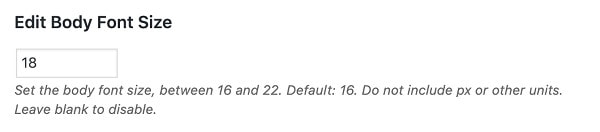
To prevent allowing people to shoot themselves in the foot with ridiculously small or large text, we've restricted the body font size to 16px - 22px.

H1 font size

The site/post-title is set to 2em, or 2x the body font size, which means that increasing the body font from 16px to 18px changes the title from 32px to 36px.

Unfortunately, this often ends up being unnecessarily large.

The Feast Plugin 7.2.0 introduces the ability to change the h1 to a custom size:

Note: this is restricted to 24px to 36px to keep it within reasonable limits. It looks like 30px is a good size regardless of body font size.

Troubleshooting

The only problem we expect people may encounter is from caching (WP Rocket, server, CDN, browser), or plugins like autoptimize. Make sure you've cleared your caches, and check your site in a private/incognito window.

Was this helpful?

  • Happy
  • Sad
Create your logoFonts

Products

  • Feast Plugin
  • Feast+
  • Feast+ White Glove
  • Feast+ Style Refresh
  • Done-for-you Services
  • Demo trial
  • Themes
  • Theme Install Service
  • Classic Themes
  • Lattice Plugin
  • Travel
  • Logo creation

Help

  • Kadence tutorials
  • Kadence Install
  • Documentation & Tutorials
  • Feast+ Members
  • Discounts & Coupons
  • Trellis 2.0
  • Trellis
  • Trellis Migration
  • Compatibility
  • Support
  • Legal resources
  • Genesis vs. Kadence
  • Changelog
  • How to start a blog course

Company

  • Privacy Policy
  • Refund Policy
  • Terms & Conditions
  • Why Feast
  • Principles & Best Practices
  • Affiliates
  • Contact
  • Opinion Disclaimer
  • AI Policy

Copyright ©  2026 · Feast Design Co. Results not typical or guaranteed. Our themes and plugins are just a small part of the overall effort involved in running a food blog. Nothing on this website shall constitute legal or financial advice, always consult a local lawyer and accountant. Accessing this website and all transactions herein are under the laws and jurisdiction of Toronto, Ontario, Canada. All pricing is USD.

  • Get the Feast Plugin
  • Documentation
    • Feast Plugin
    • Feast+
  • Open a Support Ticket
Facebook X Instagram
Search